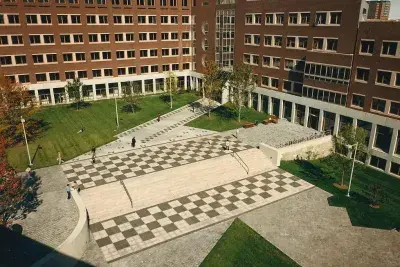
Richard Fleischner, Upper Courtyard, 1985, Photo: Steven Rosenthal
IAP Workshop: Activating Public Art through Design
January 13 - 15, 2026
Join the List Visual Arts Center and MIT Morningside Academy for Design (MAD) for a 3-day IAP workshop exploring the history and legacy of public space design.
Since 1985, the List Visual Arts Center—MIT’s contemporary art museum—has been open for free and open to the public. The List opened alongside the Media Lab in the I.M. Pei-designed Wiesner Building in what was conceived of as a hub for interdisciplinary connections across art and media. Over the course of this academic year, the List Center is celebrating this legacy of experimentation with archival presentations highlighting the original artist and architect collaborations that launched our space–a mural with Kenneth Noland, benches and balustrades by Scott Burton, and the Upper Courtyard by Richard Fleischner (pictured above; who later created Lower Courtyard in 2010).
This IAP workshop will provide students with an opportunity to reimagine how these latter works by Richard Fleischner, an influential figure in environmental art, can be better emphasized and articulated in space by leveraging the site’s unique characteristics. This project extends the List Center’s history of inquiry into how artists can play a role in designing public spaces while highlighting often-overlooked works of art. Students will design and prototype ways of framing these historic works in a collaborative setting, engaging techniques of land art, urban diagramming, and performative intervention to activate Fleischner’s Courtyards in novel ways.
The workshop will take place Tuesday, January 13 through Thursday, January 15, 2026, 10:00 AM–4:00 PM each day.
Instructor Bio
Claire Gorman Hanly is a computer scientist and environmental designer. Her research and practice focus on the implementation of deep learning-based computer vision methods in built and natural environments, with applications in regenerative agriculture, remote sensing, and cultural landscape preservation. Her work ranges geographically across glaciers and caves, river deltas and grain supply-sheds, Arctic wilderness and subtropical cities as it explores the computational signatures of constructed nature.
Claire has collaborated with technology companies, research labs, and the US National Park Service. Most recently, she has served as the Principal Curatorial Assistant to Prof. Carlo Ratti for the 19th International Exhibition at La Biennale di Venezia, leading the selection and production of more than 300 projects for the largest to-date exhibition of its kind.
At MIT, Claire is pursuing dual Masters degrees in Computer Science and Environmental Planning. Before starting her graduate studies, Claire held a research position at the MIT Senseable City Lab. Her undergraduate degree is in Computing and the Arts, from Yale University.
Sponsors